This post reports on a backtest of the systematic strategy “World 1D” over US and European equity universes (7,666 symbols), on a daily timeframe, across roughly 10 years of historical data. Over that backtest window the strategy produced a CAGR of 40% alongside a maximum drawdown of 29%, a Sortino ratio of 1.79 and a Sharpe of 1.15 over 374 trades , these figures are backtested, not live, and risk-adjusted measures must be read together with the drawdown. The strategy parameter set and full backtest output are published in real-time to our free community channels. For informational and educational purposes only , not financial advice.
\n\n\n\nThe results are presented in this first post and the building of this strategy will be presented in the next posts.
\n\n\n\nStrategyEvaluate Input Parameters
\n| Parameter | Value |
|---|---|
| strategy_buy | “bband1a&psar0a” |
| strategy_sell | “ichimoku4a+psar0a” |
| negative_cash | False |
| date_start_simulation | 2015-02-02 00:00:00+00:00 |
| date_start | 2014-01-20 00:00:00+00:00 |
| date_end | 2025-10-03 00:00:00+00:00 |
| base_currency | CHF |
| initial_cash | 100000.0 |
| position_target_w | 0.1 |
| position_target_hard_limit | 10000000.0 |
| bar_size | 1 day |
| nbar_back_for_stop | 0 |
| trailing_stop | 24.0 |
| stop_limit | False |
| nbar_freeze | 2 |
| enable_freeze_global | False |
| position_max_w | 0.25 |
| max_new_position_per_bar | 3 |
| nb_symbol | 7666 |
\n Wallet final : value=4144809 cagr=40.52% maxdd=29.02% ulcer=2.53% exposure=19.81% return=4044.81% nbtransaction=374 winrate=49.20% sharpe=1.15 sortino=1.79 calmar=1.40 stability=0.866 k=133.24 composite=43.758480 rr=5.31 nbrow=0 cash=4144809 return_mean=24.62 return_max=1620.66 return_min=-42.05 return_quantiles=-31.18 -22.91 -13.10 -1.14 22.16 127.73 392.69\n
Results Summary
\n| Metric | Value |
|---|---|
| equity_final | 4144808.9766 |
| cagr | 40.5202 |
| return | 4044.8090 |
| max_drawdown | 29.0195 |
| ulcer_index | 2.5278 |
| net_exposure | 19.8098 |
| sharpe_ratio | 1.1514 |
| sortino_ratio | 1.7926 |
| calmar_ratio | 1.3963 |
| benchmark_cagr | 9.2310 |
| nb_trades | 0 |
| win_rate | 49.1979 |
| risk_reward_ratio | 5.3060 |
| return_mean | 24.6217 |
| return_min | -42.0537 |
| return_q0.01 | -31.1833 |
| return_q0.05 | -22.9130 |
| return_q0.2 | -13.0986 |
| return_q0.5 | -1.1368 |
| return_q0.8 | 22.1602 |
| return_q0.95 | 127.7293 |
| return_q0.99 | 392.6856 |
| return_max | 1620.6617 |
| trades | 374 |
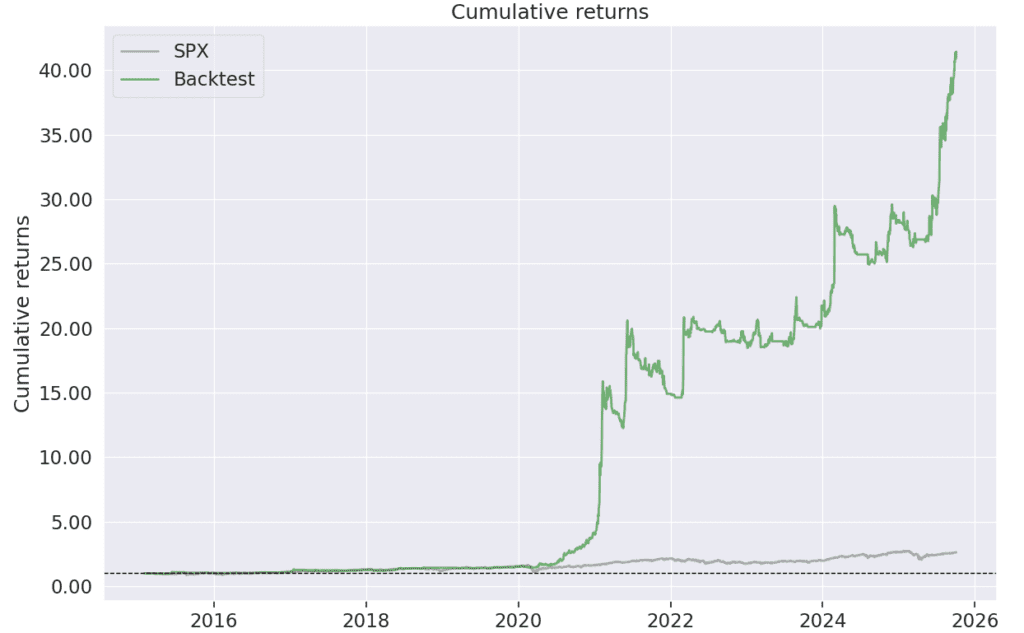
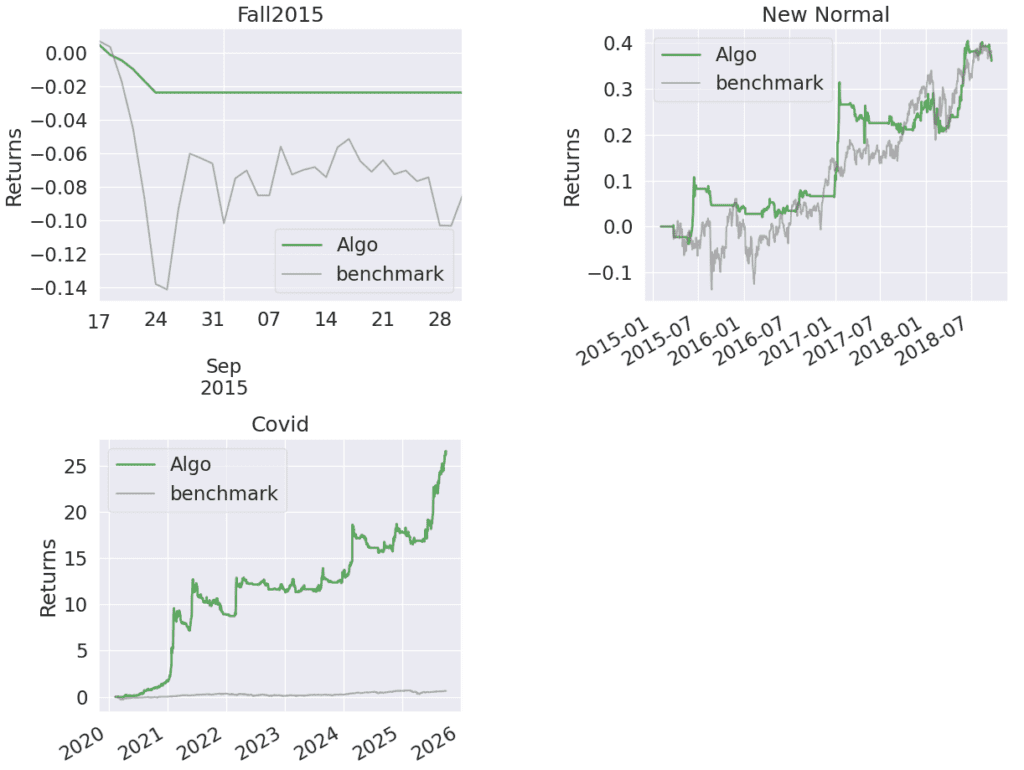
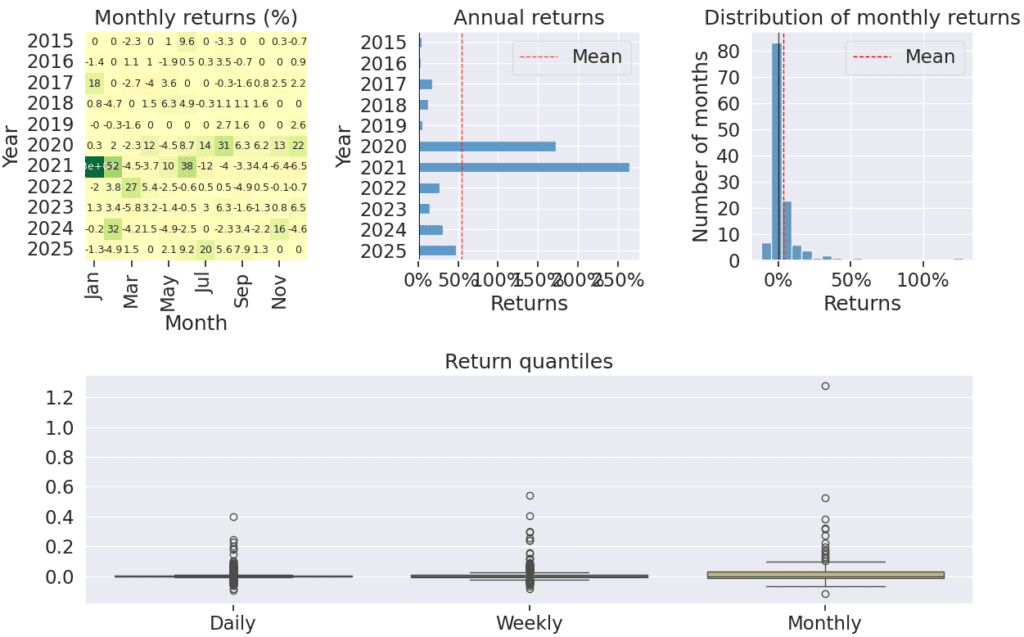
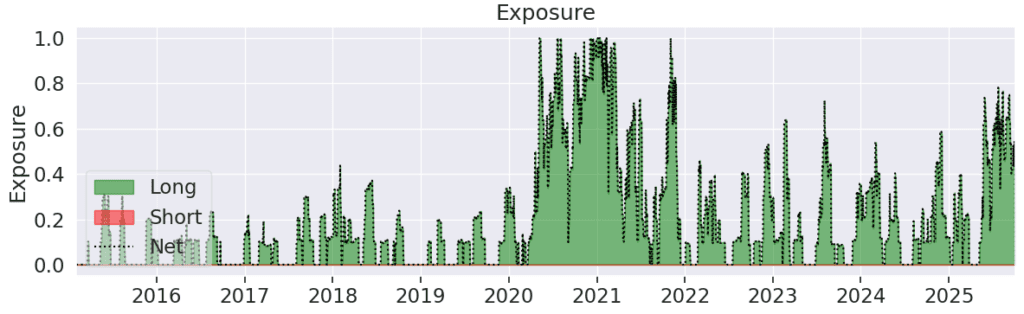
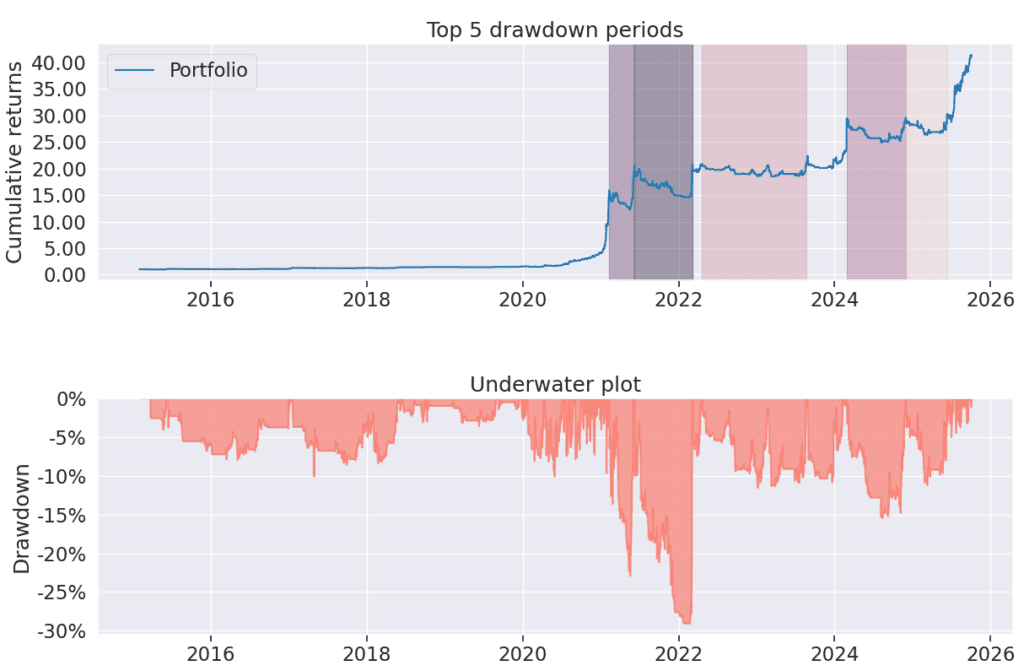
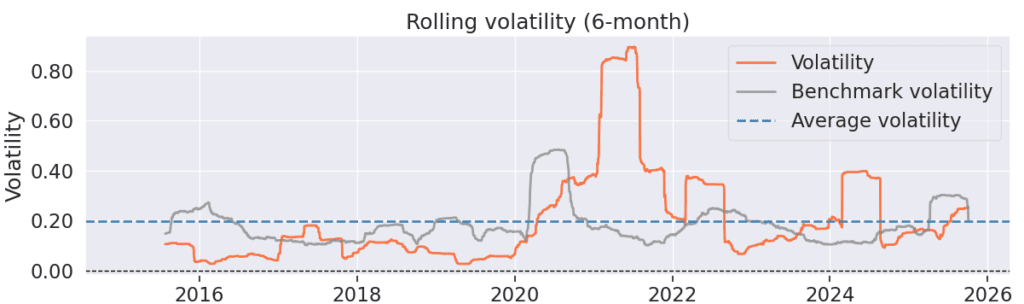
Out-of-sample cutoff. This strategy’s rules and parameters were frozen on 3 July 2025. All performance shown after that date is genuine out-of-sample / forward-tracked data , it post-dates the freeze, so no hindsight or selection could have shaped the rules.
\n\n\n\nFurther reading: we later built a market-regime filter on top of this strategy family and published the null-result study , gating these backtests by an SPX percent-rank regime did not improve them.
\n\n\n\n\n\n\nFrequently asked questions
\n\n\n\nWhat does Backtest 92 test?
\n\n\n\nA long only systematic strategy on a universe of 7,666 US and European equities using daily bars, from 2 February 2015 to 3 October 2025, starting from 100,000 CHF of capital.
\n\n\n\nWhat are the headline numbers?
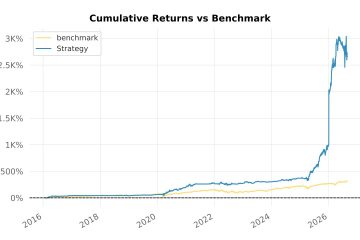
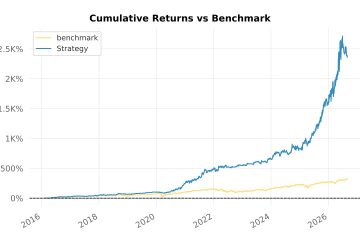
\n\n\n\nA CAGR of 40.5% against a benchmark CAGR of 9.2%, with a maximum drawdown of 29.0%. Sharpe was 1.15, Sortino 1.79 and Calmar 1.40 over 374 trades at a 49.2% win rate. The drawdown belongs next to the CAGR every time the CAGR is quoted.
\n\n\n\nHow often is the strategy invested?
\n\n\n\nNet exposure averages 19.8%, so the book sits in cash for most of the window. The exposure chart shows long only positioning with no short side.
\n\n\n\nWhich part of the record is out of sample?
\n\n\n\nThe rules and parameters were frozen on 3 July 2025, so performance after that date is genuine out of sample. Results before the freeze are in sample.
\n\n\n\nWhy is the win rate below 50% when the CAGR is high?
\n\n\n\nBecause the payoff is asymmetric. The report shows a risk reward ratio of 5.31 and a return distribution with a median trade near -1.1% and a 99th percentile near +393%. A minority of large winners carries the result, which is characteristic of trend following and also means the outcome depends on a small number of trades.
\n\n\n\nIs this financial advice?
\n\n\n\nNo. KreamEdge publishes backtests for informational and educational purposes only. Nothing here is a recommendation to buy or sell. We would not trade it as-is: it is research only. Past performance is not indicative of future results.
\n\n\n\n\n\nRelated KreamEdge research
\n\n\n\n- \n\n
- Systematic 1D strategy on world major indices (Backtest 265) \n\n\n\n
- Systematic 1D strategy on world indices + KOSPI 50 (Backtest 308) \n\n\n\n
- Combined US-equities + world-indices 1D portfolio (Backtest 332) \n\n\n\n
- Why most trading backtests are misleading (methodology) \n\n\n\n\n
- Systematic 1D strategy on US equities (Backtest 317) \n\n\n\n
- EUR 1H trading strategy (Backtest 85) \n\n

0 Comments