29% Exposure – 1.66 Sharpe – 32% Max Drawdown (2018-2026)
\n\n\n\nMost crypto backtests lead with absurd equity curves.
\n\n\n\nThis one doesn’t.
\n\n\n\nLet’s start with what actually matters:
\n\n\n\n- \n
- Net exposure: 29.4% \n\n\n\n
- Max drawdown: −32.3% \n\n\n\n
- Sharpe ratio: 1.66 \n\n\n\n
- Calmar ratio: 2.10 \n\n\n\n
- Ulcer index: 5.56% \n\n\n\n
- Trades: 71 over 8 years \n
CAGR is 67.7%, but that’s not the point.
\n\n\n\nThe point is return per unit of exposure and drawdown control.
\n\n\n\n\n\n\n\n
1. Strategy Design Philosophy
\n\n\n\nThis is not a prediction model.
\n\n\n\nIt is a regime participation system designed to:
\n\n\n\n- \n
- Enter volatility expansion phases \n\n\n\n
- Confirm structural trend alignment \n\n\n\n
- Exit aggressively when regime deteriorates \n\n\n\n
- Stay in cash most of the time \n
Average exposure over 8 years: 29%
\n\n\n\nIt avoids the structural crypto bear phases instead of trying to survive them.
\n\n\n\n\n\n\n\n
2. Architecture
\n\n\n\nEntry Layer
\n\n\n\n- \n
- Bollinger-based regime trigger (
bband2a) \n\n\n\n - Detects volatility compression → expansion \n
Exit Layer
\n\n\n\nEnsemble of:
\n\n\n\n- \n
ichimoku6a\n\n\n\nichimoku5a\n\n\n\nichimoku4a\n
Exit logic is deliberately redundant.
\n\n\n\nRisk Layer
\n\n\n\n- \n
- 32% trailing stop \n\n\n\n
- No leverage \n\n\n\n
- Position target: 40% \n\n\n\n
- Max position cap: 60% \n\n\n\n
- 7% annual interest on idle cash \n
Universe:
\n\n\n\n- \n
- 9 liquid USD crypto pairs \n\n\n\n
- Daily bars \n\n\n\n
- Long-only \n
\n\n\n\n
3. Configuration
\n\n\n\nStrategy Configuration
\n| Category | \nParameter | \nValue | \n
|---|---|---|
| Core Setup | Bar Size | 1 Day |
| Universe Size | 9 Crypto Pairs (USD) | |
| Leverage | 1.0 (No leverage) | |
| Initial Capital | $100,000 | |
| Interest on Cash | 7% Annual | |
| Signal Engine | Entry Logic | Bollinger Regime (bband2a) |
| Exit Logic | Ichimoku Ensemble (6a + 5a + 4a) | |
| Scoring Model | Weighted Composite (16 factors) | |
| Freeze Bars | 2 Bars | |
| Risk Management | Trailing Stop | 32% |
| Position Target Weight | 40% | |
| Max Position Weight | 60% | |
| Max Entries per Bar | 10 | |
| Exposure Controls | Exposure Penalty Trigger | 5% |
| Stability Penalty Trigger | 0.30 | |
| Backtest Period | Data Start | 20 Dec 2016 |
| Simulation Start | 02 Jan 2018 – 31 Jan 2026 |
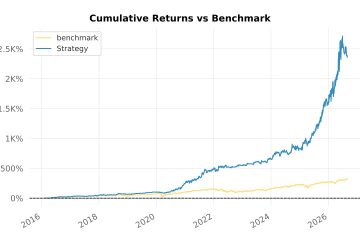
4. Performance Summary (2018-2026)
\n\n\n\nInitial capital: $100,000
Final equity: $6,531,155
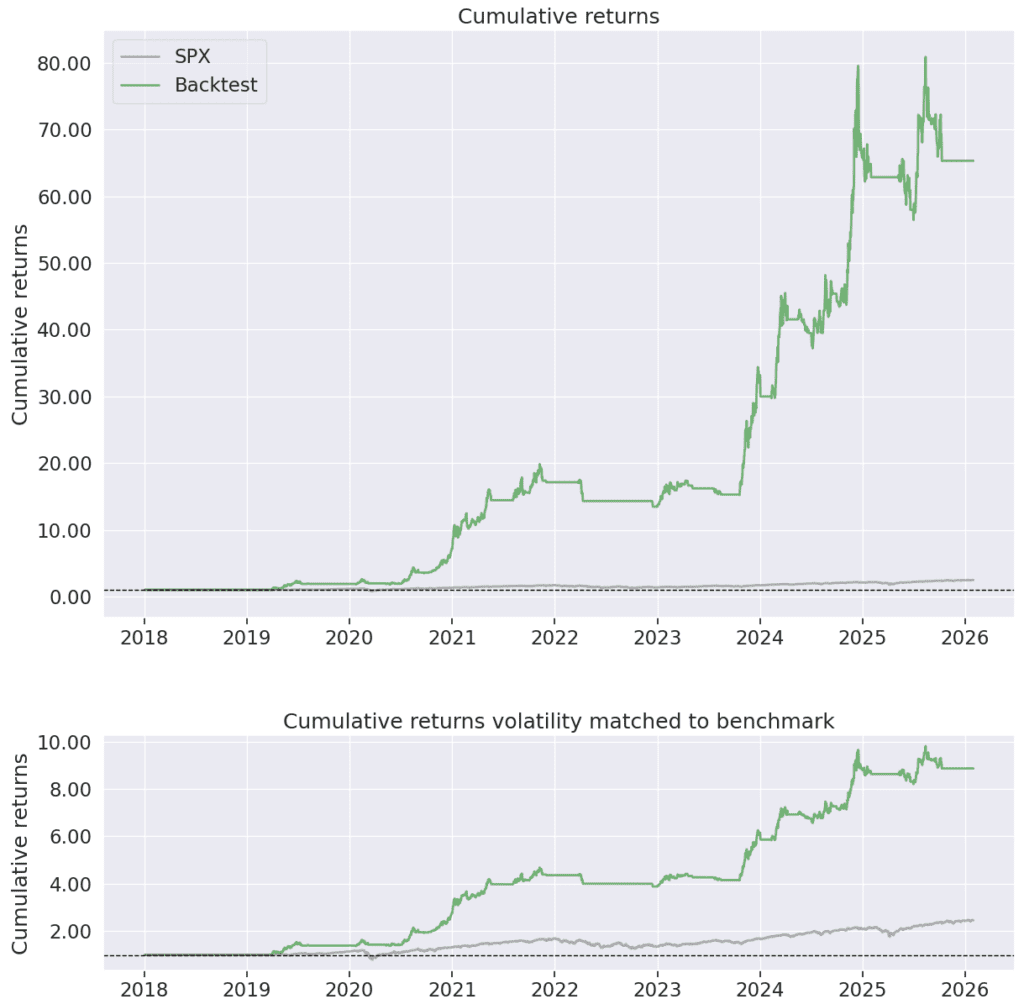
But again, focus on structure:
\n\n\n\nPerformance Summary (2018-2026)
\n| Metric | \nValue | \n
|---|---|
| Final Equity | $6,531,156 |
| Total Return | +6,431% |
| CAGR | 67.74% |
| Max Drawdown | −32.26% |
| Ulcer Index | 5.56% |
| Sharpe Ratio | 1.66 |
| Sortino Ratio | 2.53 |
| Calmar Ratio | 2.10 |
| Stability | 0.935 |
| K-Ratio | 203.41 |
| Net Exposure | 29.40% |
| Trades | 71 |
| Win Rate | 60.56% |
| Risk / Reward | 7.76 |
| Kelly Fraction | 55.48% |
71 trades in 8 years.
\n\n\n\nThis is a slow, selective trend system, not hyperactive trading.
\n\n\n\n\n\n\n\n
5. Distribution Profile
\n\n\n\nTrade return distribution:
\n\n\n\n- \n
- Median: +3.0% \n\n\n\n
- 80th percentile: +54% \n\n\n\n
- 95th percentile: +192% \n\n\n\n
- Worst trade: −25.9% \n
This is clearly positively skewed.
\n\n\n\nPerformance is driven by:
\n\n\n\n- \n
- Few large structural trend captures \n\n\n\n
- Limited downside per trade \n\n\n\n
- Strict exit discipline \n
It does not rely on high win rate.
It relies on asymmetric payoff.
\n\n\n\n
6. Risk Characteristics
\n\n\n\nDrawdown Profile
\n\n\n\n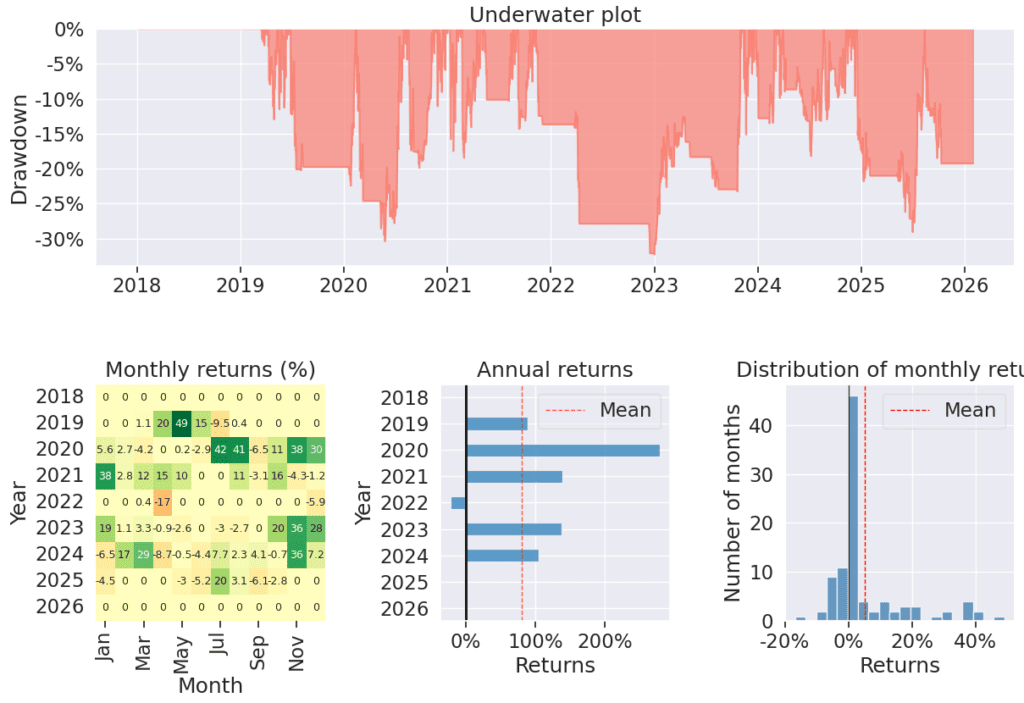
Max DD: −32%
\n\n\n\nIn crypto terms, that is materially lower than passive exposure.
\n\n\n\nMore important:
\n\n\n\nUlcer index = 5.56%
Meaning drawdowns are not only shallow, but relatively short-lived.
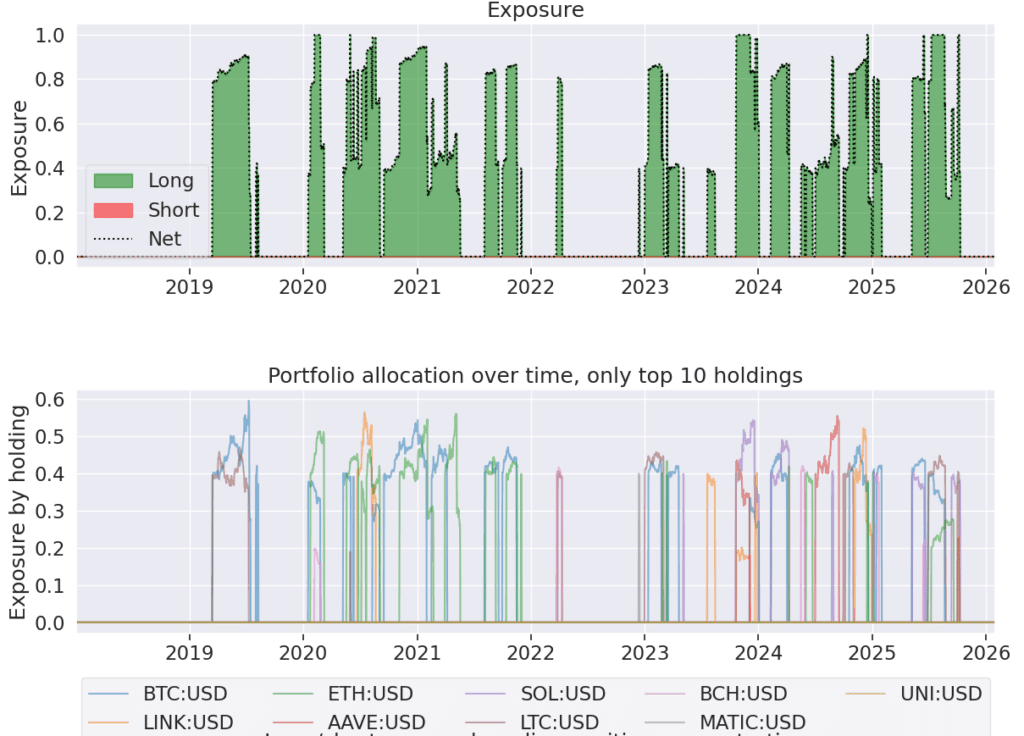
Stability
\n\n\n\nStability score: 0.935
K-ratio: 203
The equity curve is statistically smooth relative to asset volatility.
\n\n\n\nThat suggests:
\n\n\n\n- \n
- Regime filtering is doing real work \n\n\n\n
- Not pure beta harvesting \n
\n\n\n\n
6. What This Is NOT
\n\n\n\nLet’s be explicit:
\n\n\n\n- \n
- Not slippage-stress-tested yet \n\n\n\n
- No liquidity impact modeling \n\n\n\n
- Universe limited to 9 assets \n\n\n\n
- Crypto structural bull market tailwind (2020-2021) \n\n\n\n
- Trailing stop execution on daily bars may overestimate fills \n
This is research-grade, not audited live performance.
\n\n\n\n\n\n\n\n
7. Why This Is Interesting
\n\n\n\nThe key metric here is:
\n\n\n\n67% CAGR at 29% exposure
\n\n\n\nIf exposure were 100%, risk profile would be completely different.
\n\n\n\nThis suggests the system is:
\n\n\n\n- \n
- Efficient at timing participation \n\n\n\n
- Avoiding large bear regimes \n\n\n\n
- Capturing convexity phases \n
That is structurally different from buy-and-hold.
\n\n\n\n\n\n\n\n
8. What Needs to Be Proven Next
\n\n\n\nBefore considering capital deployment:
\n\n\n\n- \n
- Walk-forward optimization \n\n\n\n
- Parameter perturbation test (±20% sensitivity) \n\n\n\n
- Slippage stress test (0.1-0.5%) \n\n\n\n
- Sub-universe validation \n\n\n\n
- Post-2024 strict out-of-sample monitoring \n\n\n\n
- Exposure cap reduction to 20% to test robustness \n
If performance collapses under minor perturbations, edge is fragile.
\n\n\n\nIf not, we may have something durable.
\n\n\n\n\n\n\n\n
9. Bottom Line
\n\n\n\nThis is not about turning $100k into $6M.
\n\n\n\nIt’s about:
\n\n\n\n- \n
- Controlled participation \n\n\n\n
- Positive skew \n\n\n\n
- Low exposure efficiency \n\n\n\n
- Stable equity compounding \n
The next step is robustness validation – not marketing.
\n\n\n\nOut-of-sample cutoff. This strategy’s rules and parameters were frozen on 3 July 2025. All performance shown after that date is genuine out-of-sample / forward-tracked data – it post-dates the freeze, so no hindsight or selection could have shaped the rules.
\n\n\n\nThis is a historical backtest, published for informational and educational purposes only – not financial advice, not a recommendation, and not a trading signal. We would not trade it as-is: it is research only. Past performance is not indicative of future results.
\n\n\n\n\nBacktest output and ongoing research:
→ Community channels
→ https://x.com/kreamedge
See the discussion on X/Twitter.
\n\n\n\n\n\n\n\n\nFrequently asked questions
\n\n\n\nWhat does this crypto backtest test?
\n\n\n\nA long only, daily bar systematic strategy on nine liquid USD crypto pairs from 2 January 2018 to 31 January 2026, starting from 100,000 USD with no leverage.
\n\n\n\nWhy lead with exposure instead of CAGR?
\n\n\n\nBecause average net exposure is 29.4%, so the book is in cash roughly seven days in ten. The CAGR of 67.7% was earned on that fraction of participation. Return per unit of exposure and drawdown control are the informative measures; the headline growth number on its own is not.
\n\n\n\nHow deep did the drawdown go?
\n\n\n\nThe maximum drawdown was 32.3%, with an Ulcer index of 5.56%. Sharpe was 1.66 and Calmar 2.10 over 71 trades in eight years.
\n\n\n\nHow does the strategy handle crypto bear markets?
\n\n\n\nIt exits rather than endures. Entry is a Bollinger based volatility expansion trigger, the exit layer is a deliberately redundant Ichimoku ensemble, and a 32% trailing stop caps the loss on any single position. The design avoids the structural bear phases instead of trying to sit through them.
\n\n\n\nIs 71 trades enough to draw conclusions from?
\n\n\n\nIt is a small sample and the post treats it as one. Seventy one trades over eight years means the result rests on a handful of regime participations, so the uncertainty around any risk adjusted statistic here is wide. Sample size is part of the evidence, not a footnote to it.
\n\n\n\n\n\n

0 Comments