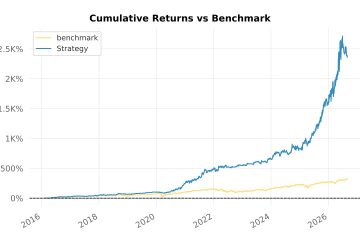
Backtest 317 evaluates a long-only, daily-bar systematic strategy on a broad universe of 4,176 US-listed equities from 1 March 2016 to 30 April 2026 (≈ 10 years 2 months). Over that window the strategy compounds to a CAGR of 30.4% versus the S&P 500 total-return benchmark at 13.8%, with a max drawdown of -17.70% against the benchmark’s -33.92% – while holding positions only 78% of the time.
\n\n\n\nThis is a historical backtest, not a live track record and not a trading signal. We would not trade it as-is: it is research only. Past performance is not indicative of future results. Content is published for informational and educational purposes only – see the closing notes and our community page for the full disclaimer.
\n\n\n\nHeadline numbers
\n\n\n\n| Metric | Strategy | Benchmark (SPX TR) |
|---|---|---|
| Period | 2016-03-01 → 2026-04-30 | |
| CAGR | 30.41% | 13.80% |
| Cumulative return | +1,394% | +273% |
| Max drawdown | -17.70% | -33.92% |
| Longest DD (days) | 448 | 745 |
| Volatility (annualised) | 20.30% | 17.93% |
| Sharpe | 0.78 | 0.10 |
| Sortino | 1.35 | 0.14 |
| Calmar | 1.72 | 0.41 |
| Time in market | 78% | 100% |
| Gross exposure (avg) | 36% | – |
| Beta to SPX | 0.20 | – |
| Trades | 818 | – |
| Win rate | 53.30% | – |
| Risk / reward | 1.75 | – |
| Skew | +3.33 | -0.38 |
| Kurtosis | 57.25 | 16.21 |
Universe & period
\n\n\n\nThe universe is the US-equities zone – 4,176 US-listed stocks, daily bars, denominated in USD. This is a much wider cross-section than our world major-index studies, which changes the character of the strategy: with thousands of candidates the entry logic can be selective, and average gross exposure sits around 36% with the book in the market only 78% of the time. The simulation warms up indicators from 2014-12-19 and starts compounding from 2016-03-01 with $100,000 of initial capital, ending 2026-04-30.
\n\n\n\nStrategy in plain English
\n\n\n\n- \n
- Long-only, no shorts, no leverage. \n
- Entry: a MACD-variant trigger (internally
macdv3b). \n - Exit: a composite of a moving-average rule and a VIX-based filter (internally
ma0a+vix0b), combined with a 14% trailing stop. \n - Sizing: volatility-targeted at the portfolio level, position cap 20%, sector cap 33%, max 10 new entries per bar. \n
- Cooldown: a freeze of 2 bars after each exit to avoid immediate re-entries. \n
- Regime awareness: a 252-bar percentile-based regime filter. Over the test window bars classify as ~78% trend, ~8% range, ~15% bear (see our follow-up null-result study on whether this filter actually improves backtest outcomes) – the strategy is permitted in all three but sizes down outside trend. \n
Equity curve
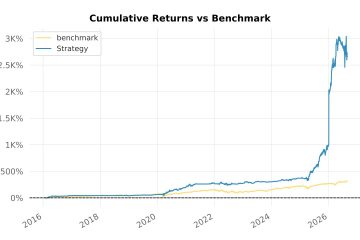
\n\n\n\n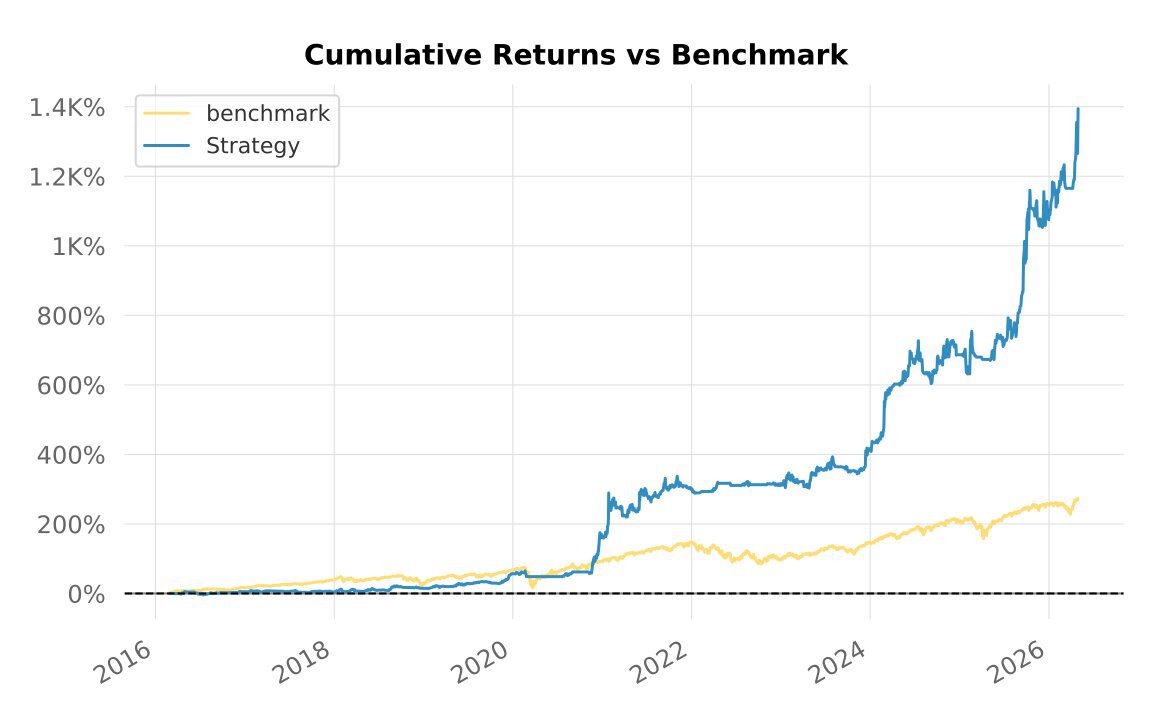
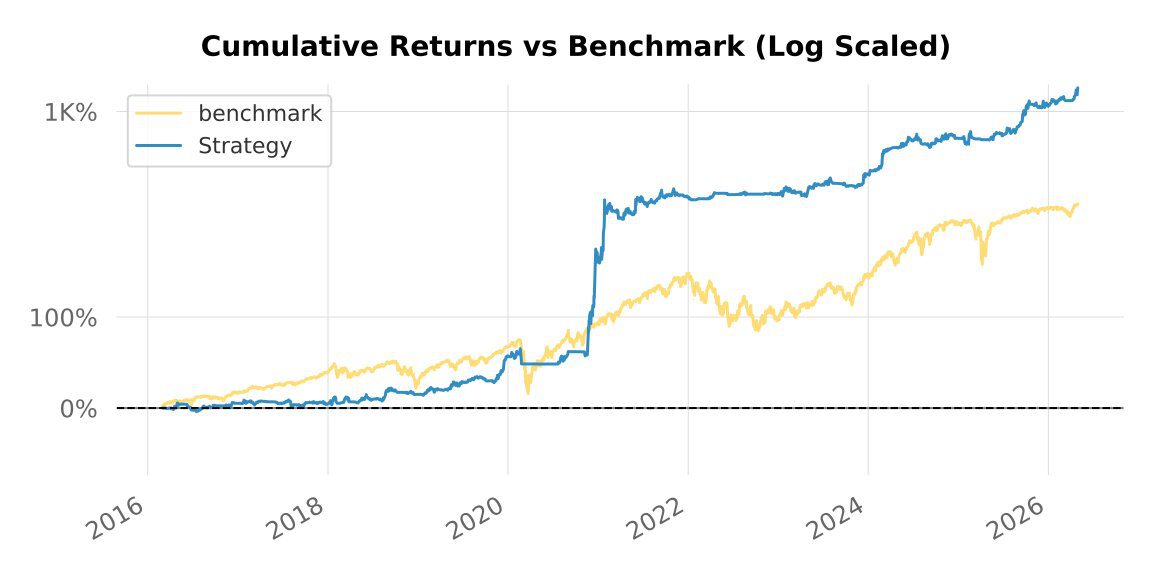
Annual returns
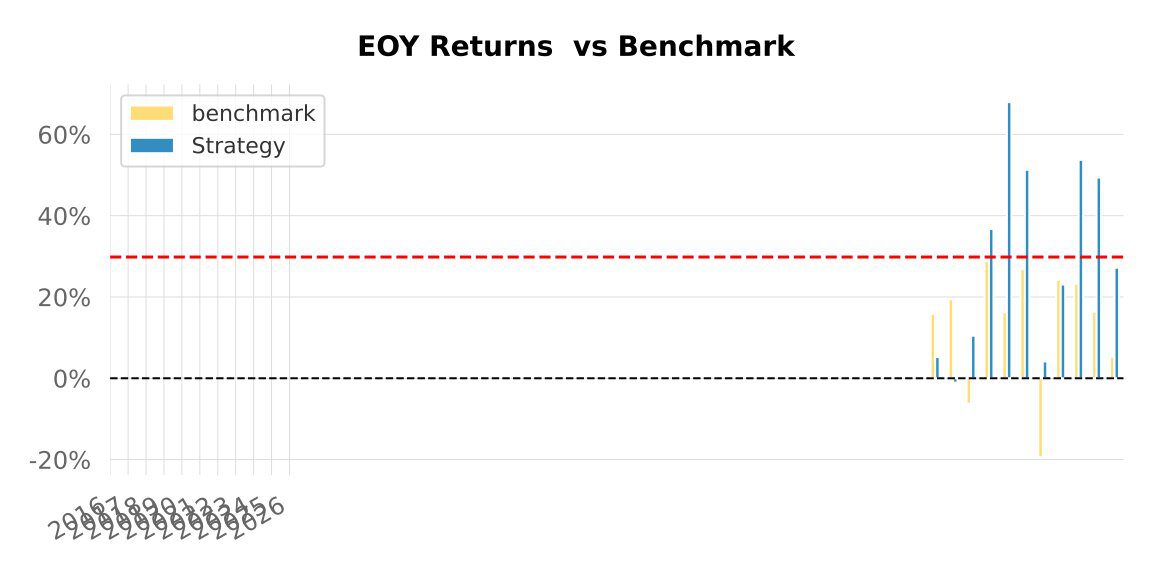
\n\n\n\n| Year | SPX | Strategy | Multiplier | Won |
|---|---|---|---|---|
| 2016 | 15.87% | 5.22% | 0.33 | – |
| 2017 | 19.42% | -1.06% | -0.05 | – |
| 2018 | -6.24% | 10.46% | -1.68 | + |
| 2019 | 28.88% | 36.71% | 1.27 | + |
| 2020 | 16.26% | 67.92% | 4.18 | + |
| 2021 | 26.89% | 51.28% | 1.91 | + |
| 2022 | -19.44% | 4.12% | -0.21 | + |
| 2023 | 24.23% | 23.05% | 0.95 | – |
| 2024 | 23.31% | 53.72% | 2.30 | + |
| 2025 | 16.39% | 49.37% | 3.01 | + |
| 2026* | 5.31% | 27.19% | 5.12 | + |
Drawdown analysis
\n\n\n\nThe deepest drawdown sits at -17.70% (Jan-Jun 2021), deeper than our world-index strategies but still roughly half the benchmark’s -33.92% peak-to-trough. The longest underwater stretch ran 448 days through the 2021-2023 chop. All of the worst-ten drawdowns had recovered before the end of the sample – there is no open drawdown in this record.
\n\n\n\n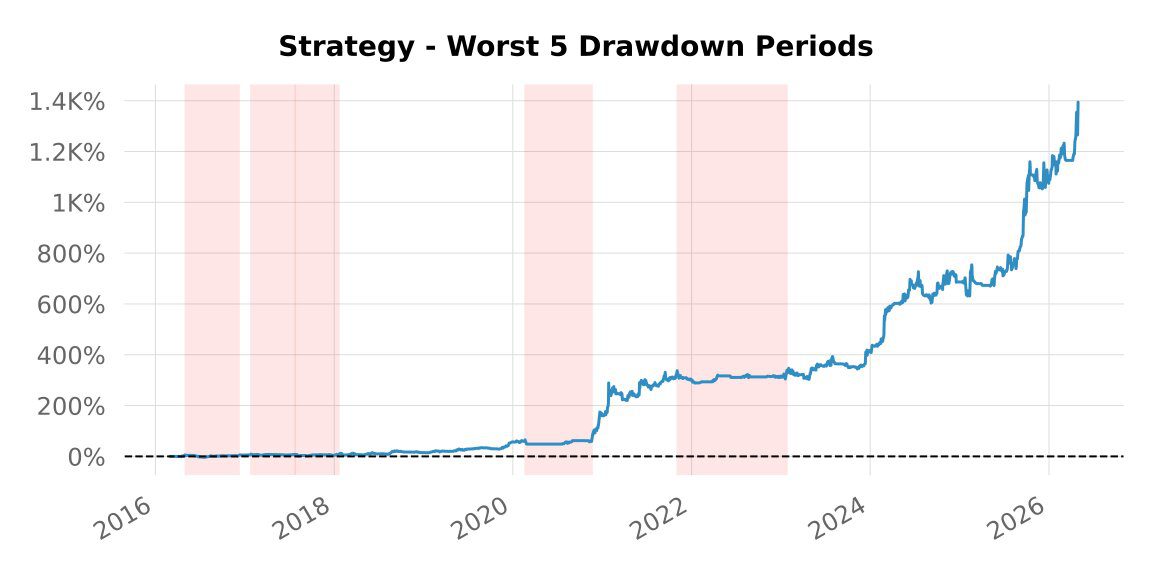
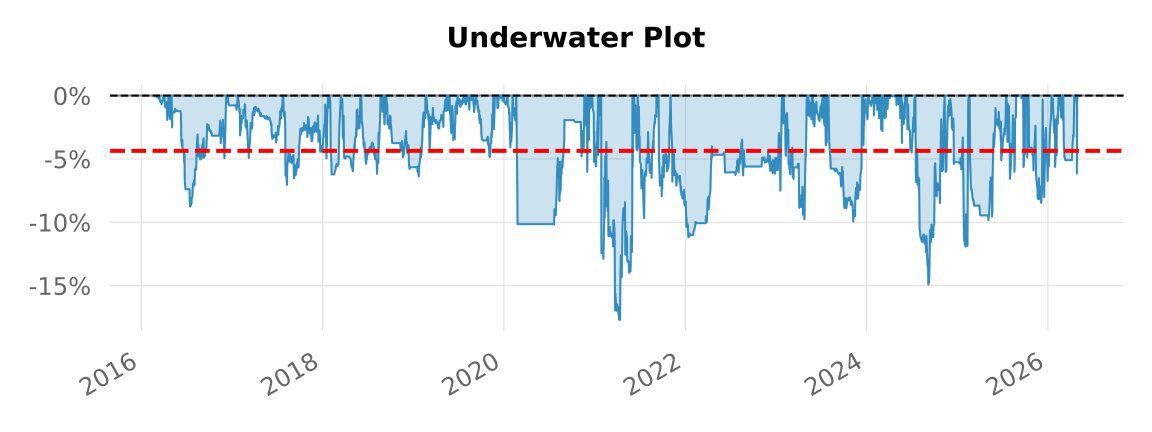
| Started | Recovered | Drawdown | Days |
|---|---|---|---|
| 2021-01-28 | 2021-06-01 | -17.70% | 125 |
| 2024-07-17 | 2024-11-08 | -14.92% | 115 |
| 2024-11-12 | 2025-02-14 | -11.92% | 95 |
| 2021-11-04 | 2023-01-25 | -11.18% | 448 |
| 2020-02-21 | 2020-11-19 | -10.20% | 273 |
| 2023-08-01 | 2023-12-13 | -9.93% | 135 |
| 2025-02-20 | 2025-07-15 | -9.83% | 146 |
| 2023-02-03 | 2023-05-05 | -9.76% | 92 |
| 2021-06-25 | 2021-09-07 | -9.68% | 75 |
| 2016-05-03 | 2016-12-07 | -8.75% | 219 |
Rolling metrics
\n\n\n\n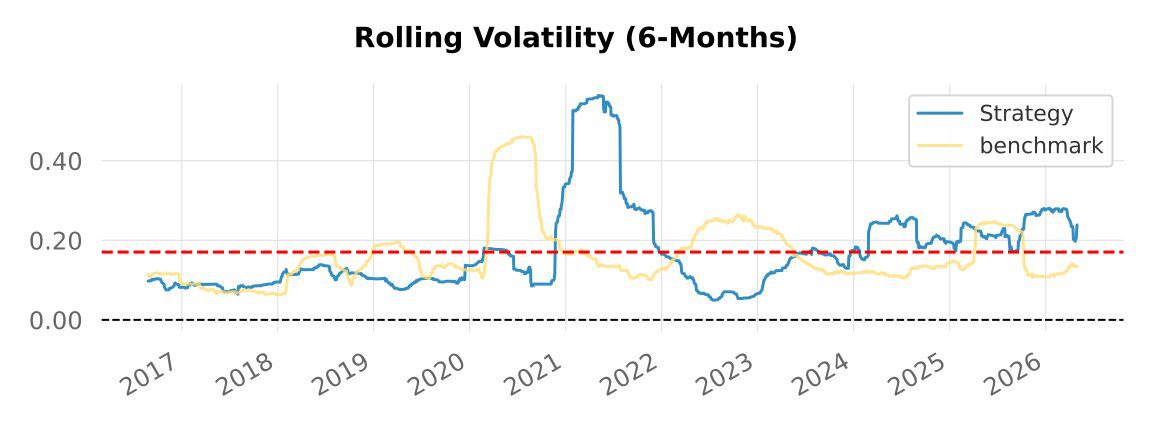
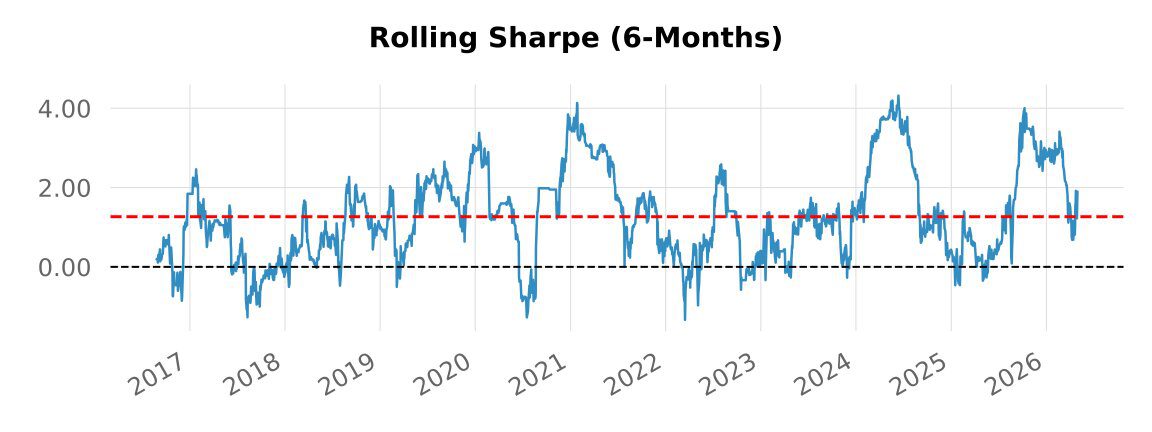
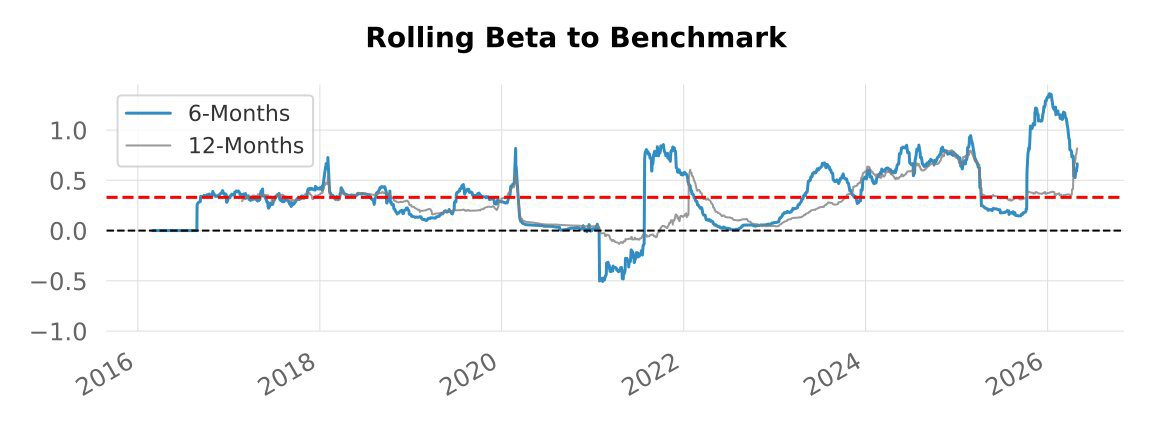
Return distribution
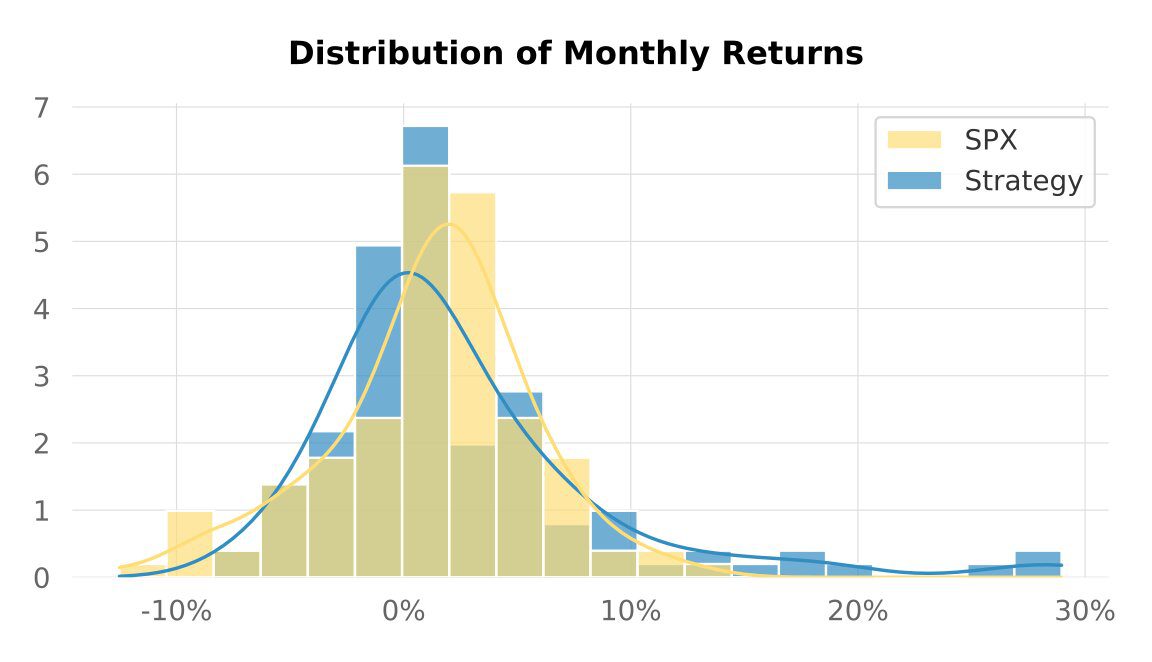
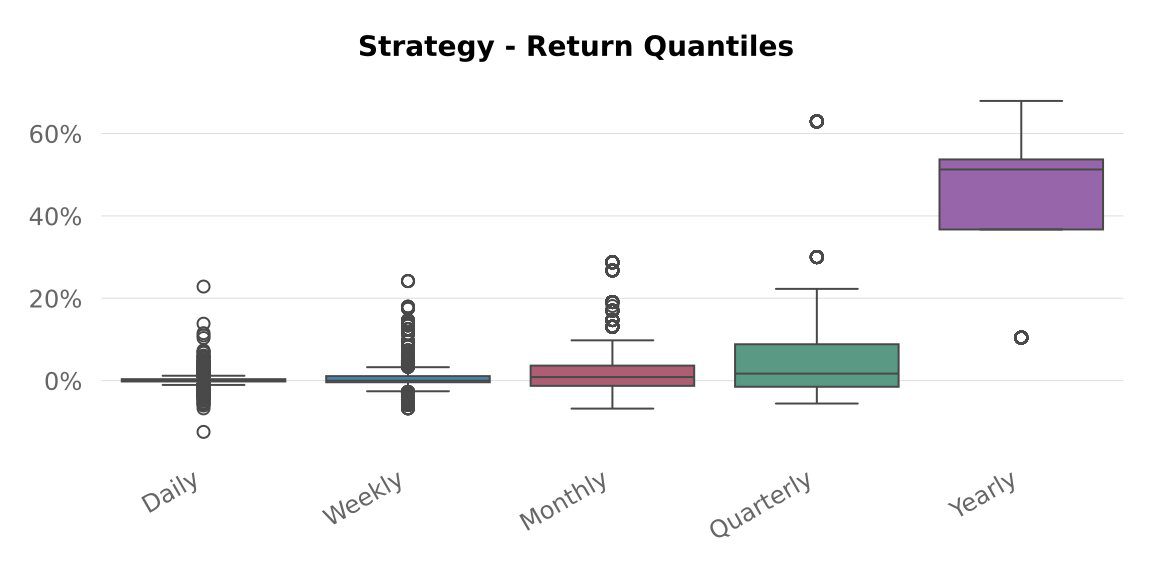
\n\n\n\nTwo distribution stats deserve a flag: skew of +3.33 and kurtosis of 57.25. That is a heavily right-tailed, fat-tailed profile – a relatively small number of very large up-days carry a disproportionate share of the compounding. Positive skew is the friendly direction (the surprises are mostly to the upside), but extreme kurtosis is also a fragility signal: results that lean on a handful of outliers are more sensitive to whether those specific days survive different cost, slippage and universe assumptions. Read the headline CAGR with that in mind.
\n\n\n\n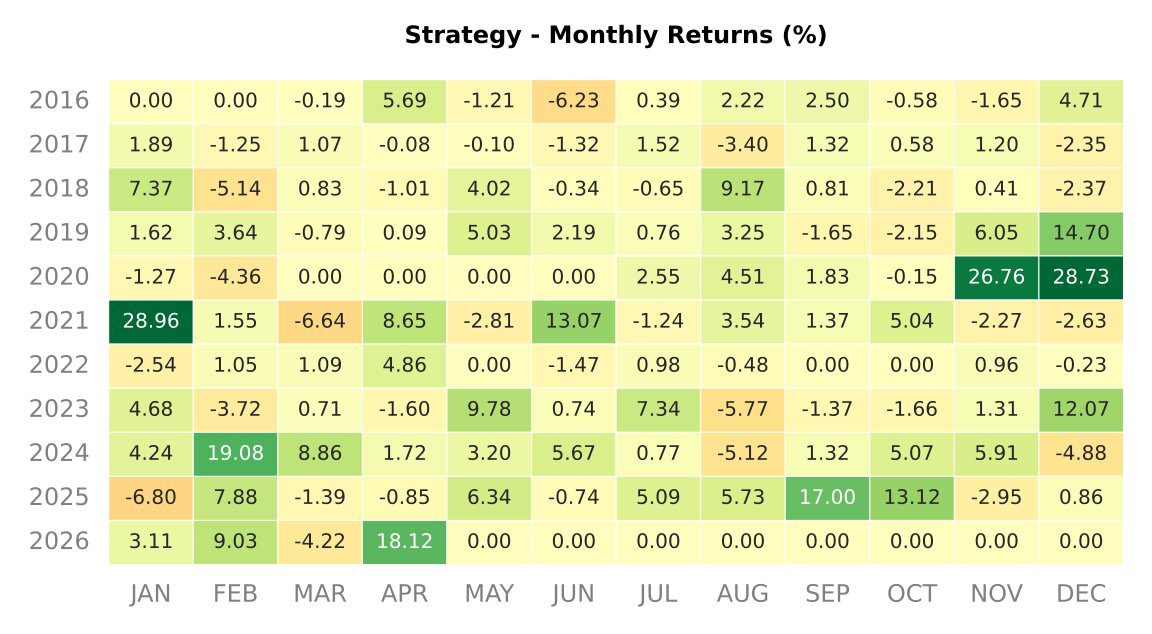
Caveats & reading guide
\n\n\n\n- \n
- This is a backtest, not a live track record. Trades are simulated on historical daily bars; real-world execution would face additional slippage, partial fills, and venue-specific frictions. \n
- Outlier-driven distribution. Skew +3.33 and kurtosis 57.25 mean a handful of large up-days do a lot of the work. That is exactly the kind of profile that can degrade under different cost or universe assumptions – treat the CAGR as fragile, not bankable. \n
- Breadth and liquidity. A 4,176-name US universe includes small and less-liquid stocks. Real fills on the thinner names would be worse than the bar-level model assumes; a liquidity-filtered re-run would be a fairer test. \n
- Survivorship. The universe is built from current and historical listings; while care is taken to include delisted names, residual survivorship bias cannot be ruled out. \n
- Risk-free rate. The QuantStats report uses a high annual RF (13.6%, inherited from a working assumption), which mechanically suppresses the printed Sharpe. An RF-flat internal calculation reports Sharpe 0.81, Sortino 1.02 and Calmar 1.69 over the same window. \n
- Costs. Transaction costs, a value-traded borrow-fee model (0.8%) and a 1.5% margin spread are modelled at the bar level; the strategy turns over ~80 trades per year on average (818 total). \n
- Out-of-sample. Parameter selection used the early portion of the window; results from 2020 onward give a more honest read of out-of-sample behavior. The weak 2016-2017 stretch (including a -1.06% year against a +19% market) is part of the honest picture. Hard cutoff: the strategy’s rules and parameters were frozen on 3 July 2025, so all performance after that date is genuine out-of-sample / forward-tracked data – unseen at selection time, with no hindsight possible. \n
Discuss this backtest
\n\n\n\nWe share backtest research, methodology notes and discussion on our free community channels – Telegram, Discord, X. Full details and the bilingual disclaimer on the community page.
\n\n\n\nKreamEdge publishes systematic strategy backtests and market analytics for informational and educational purposes only – not personalized investment advice. We would not trade the configuration shown here as-is; it is research. Past performance is not indicative of future results.
\n\n\n\n\n\nFrequently asked questions
\n\n\n\nWhat universe does Backtest 317 cover?
\n\n\n\n4,176 US listed equities on daily bars, denominated in USD, from 1 March 2016 to 30 April 2026. This is a far wider cross section than the world major index studies.
\n\n\n\nWhat were the headline results?
\n\n\n\nA CAGR of 30.41% against 13.80% for the SPX total return benchmark, with a maximum drawdown of 17.70% against the benchmark’s 33.92%, while holding positions only 78% of the time.
\n\n\n\nHow much capital is actually deployed?
\n\n\n\nAverage gross exposure is 36% and time in market is 78%. Beta to SPX is 0.20, so most of the return is not index exposure in disguise.
\n\n\n\nWhat does the skew of +3.33 mean here?
\n\n\n\nThe return distribution is strongly right tailed, against a skew of -0.38 for the benchmark, with a kurtosis of 57.25. A small number of very large winners carries the result. That is a strength on the way up and a dependency risk, because the outcome hinges on a few positions rather than a broad average.
\n\n\n\nWhy does a wider universe change the strategy’s character?
\n\n\n\nWith thousands of candidates the entry logic can be more selective per name, so the book concentrates on the strongest signals rather than taking what a narrow index list offers. That shows up as lower time in market and lower gross exposure than the index constituent studies.
\n\n\n\nIs the reported Sharpe comparable with other reports?
\n\n\n\nOnly with the risk free assumption stated. This report sets it at 13.6%, giving 0.78. A flat risk free computation gives Sharpe 0.81, Sortino 1.02 and Calmar 1.69 over the same window.
\n\n\n\n\n\nRelated KreamEdge research
\n\n\n\n- \n\n
- Combined US-equities + world-indices 1D portfolio (Backtest 332) \n\n\n\n
- Systematic 1D strategy on world indices + KOSPI 50 (Backtest 308) \n\n\n\n
- Systematic 1D strategy on world major indices (Backtest 265) \n\n\n\n
- Why most trading backtests are misleading (methodology) \n\n\n\n\n
- Market-regime filter null result \n\n

0 Comments